Since mid-1994 the Company has focused exclusively on the commercial
development of proprietary intrinsically conductive polymer (ICP) materials.
Eeonyx Corporation is proud to offer two lines of advanced products:
Electrically conductive EEONOMER® powders and
EeonTexTM Conductive Textiles.
The Company’s
EEONOMER® materials are unique compositions of matter and have been
developed and offered primarily as new alternative conductive additives to
render traditional plastics and thermosets conductive. Results to date indicate our products
will satisfy specialty niche markets where conventional conductive additives,
such as unmodified carbon black, are either unsuitable or less than wholly
satisfactory. For example, Eeonyx customers are producing static control laminates
for electronic applications. We also have an advanced development program for the use
of EEONOMER® in nylon for carpet fiber and in polyester for apparel.
A few other development programs include conductive thermosetting resins for the
semiconductor market and injection molded thermoplastic containers for the
electronics market. As a second thrust, we are also investigating the potential
value of our technology in anticorrosive coatings applications where initial
favorable results have been reported.
In general, our EEONOMER® products can be chemically tuned to
provide optimized compatibility with host polymer systems. This optimization
capability is critical to provide improved end-product performance.
The Company’s
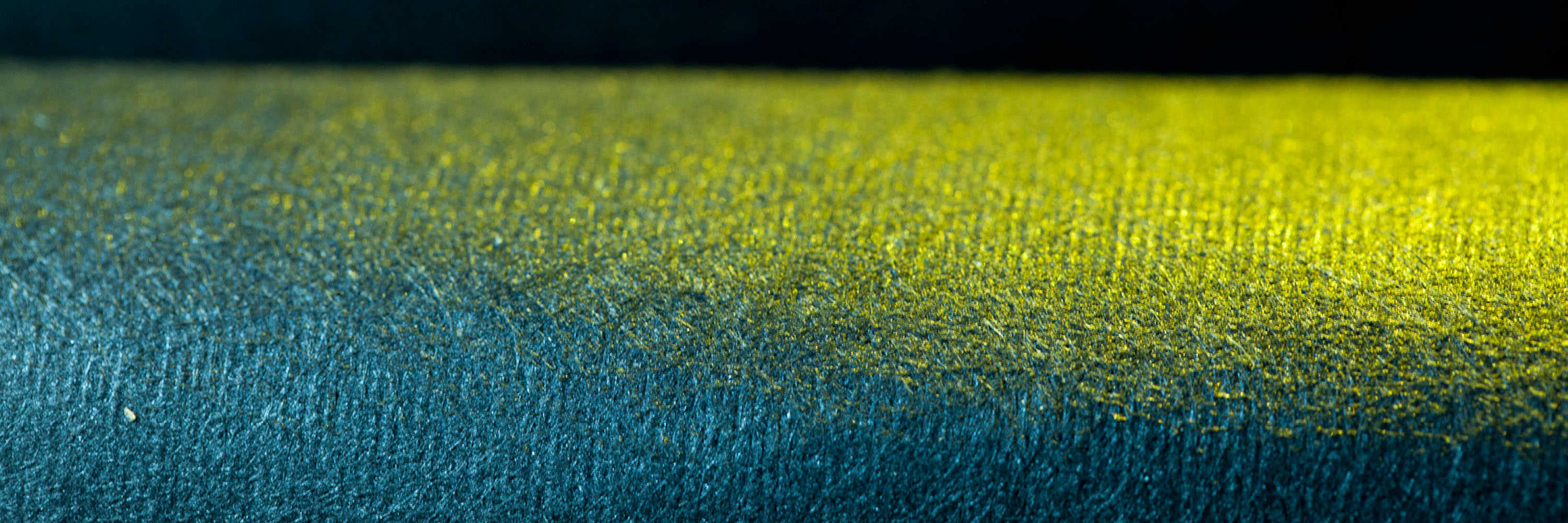
EeonTexTM conductive textiles are unique materials made using a proprietary
coating technology developed by a leading textile company.
Individual fibers within a fabric or yarn are completely and
uniformly coated with doped polypyrrole (PPY), an inherently
conducting polymer. Almost all fabrics - woven, knitted,
and nonwoven - and textured and spun yarns - synthetic or natural -
can be coated using the aqueous process. Typical substrates include
polyester, nylon, glass, and Kevlar®. While imparting electrical
conductivity and a dark color to the substrates, the coating process
barely affects the strength, drape, flexibility, and porosity of the
starting substrates. Fabrics are tailor-made for desired resistance,
thickness, porosity, surface area, flame-resistance, etc.